Friday, March 19, 2010

Up the Steps, Down the Slide

Up the Steps, Down the Slide by Jonathan Allen, 1992

Brief annotation:
Rhyming text and illustrations featuring a pair of cats present such opposites as over and under, on and off, and open and shut.
Themes include rhyming and repetition to illustrate opposites and get children guessing what will come next.

This book is a good introduction to opposites that occur in everyday life. The rhyming gets young readers involved by introducing vocabulary that they quickly become familiar with and are able to fill in the blanks on second reads. Good for new readers as well to build confidence and maybe get to read in front of their classmates.

One Gorilla: A Counting Book


One Gorilla: A Counting Book by Atsuko Morozumi, 1990

Brief annotation
One very playful gorilla keeps popping up in gardens, forests, jungles, and even people's houses as he takes the reader on a wild counting adventure. He hides--as much as a gorilla can!--along with all the other creatures as they dart, leap, and peer from the most surprising places, waiting to be counted. A chart at the end of the book provides a key to all the animals and their corresponding numbers. Soft, precise illustrations characterize this colorful counting book.
Themes include counting, nature and repetition.

This is a fun and colorful book to get young children involved in counting as well as identifying the animals that appear on the page.

The Absolutely Awful Alphabet


The Absolutely Awful Alphabet by Mordicai Gerstein, 1999

Brief annotation:
An alliterative alphabet book presents mean and monstrous letters, from A (an awfully arrogant amphibian) to Z (a zig-zagging zoological zany).
Themes include alliteration, ABC's and interesting monsters/creatures.

This book is a fresh way to look at the alphabet. Instead of A is for Apple, you get an awfully arrogant amphibian. It is a great opportunity to talk about nouns, adjectives and adverbs. It would also be a fun way to introduce alliteration in a poetry unit.

Friday, March 12, 2010

Because of Winn-Dixie


Because of Winn-Dixie by Kate DiCamillo, 2000

Brief annotation:
Ten-year-old India Opal Buloni describes her first summer in the town of Naomi, Florida, and all the good things that happen to her because of her big ugly dog Winn-Dixie.
Themes include loneliness, friendship, family and the relationships between dogs and people.

This book would be a good book for a class to read together. Discuss questions could include:
If you ate one of Miss Franny's Littmus Lozenges, what would it taste like to you?
What do you think of the preacher as a father?
What is the significance of the various friendships Opal forms over her first summer in Florida? What does she learn from this diverse group of people?
How do you think Winn-Dixie changed the people whose lives he touched? Was his impact more significant on some characters than others?

Tuesday, March 9, 2010

Esperanza Rising


Esperanza Rising by Pam Munoz Ryan, 2000

Brief annotation:
Esperanza and her mother are forced to leave their life of wealth and privilege in Mexico to go work in the labor camps of Southern California, where they must adapt to the harsh circumstances facing Mexican farm workers on the eve of the Great Depression.
Themes include immigration, family, minorities and responsibility.

This story is a good look at the conditions for minorities and immigrants during the Great Depression. It could be paired with current events topics of immigration.

- Pura Belpre Award, 2002

Sunday, March 7, 2010

Angelo


Angelo by David Macaulay, 2002

Brief annotation:
While restoring the front of a church, an old plasterer rescues several injured pigeons and nurses them back to health.
Themes include architectural conservation and restoration, wildlife rescue, friendship and death.

This is a good read aloud about friendship. It could lead to an interesting discussion about how Angelo and the pigeon helped each other even though they aren't a likely pair.

The Way We Work


The Way We Work by David Macaulay, 2008
Brief annotation
Many of us spend most of our lives oblivious to even basic information about the most amazing thing we'll ever take for granted-our own bodies. In The Way We Work, David Macaulay gives readers an opportunity to discover just how remarkable the human body really is. This comprehensive and entertaining resource reveals the inner workings of the human body and all of its systems and mechanisms, as only David Macaulay could. Page after page of beautifully illustrated spreads detail everything from cells to the bones and organs they build, clearly explaining the function of each, and offering up-close glimpses, unique cross-sections and perspectives, and even a little humor along the way. This book is for you and everyone you know. It can serve as a reference for children of all ages, families, teachers, and anyone who has questions about how their body works. This informative and engaging guide introduces you to you, and you will come away with a new appreciation of the amazing world inside yourself. When you open the cover you will see how David Macaulay builds a body and explains THE WAY WE WORK. There is no other book like it!
Themes include human physiology and anatomy and understanding your own body.

This would be a good book to use in health or physical education classes. It can be used as a reference book for projects.

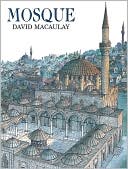
Mosque


Mosque by David Macaulay, 2003

Brief annotation:
An author and artist who has continually stripped away the mystique of architectural structures that have long fascinated modern people, David Macaulay here reveals the methods and materials used to design and construct a mosque in late-sixteenth- century Turkey. Through the fictional story and Macaulay’s distinctive full-color illustrations, readers will learn not only how such monumental structures were built but also how they functioned in relation to the society they served.
As always, Macaulay has given a great deal of attention to the relationship between pictures and text, creating another brilliant celebration of an architectural wonder.
Themes include architecture, 16th century Turkish civilation and culture. Cultural understanding and diversity.

This is a great book to use to give a better understanding of Muslim culture during the 16th century. It is not trying to convince anyone of anything and therefor should not be at all contravorsal. It simply is a look at a moment in time, just as Cathedral and Pyramid look at the entire civilazation surrounding the building of the catherdral and the pyramid.

Cathedral


Cathedral by David Macaulay, 1973

Brief annotation:
Text and detailed drawings follow the planning and construction of a magnificent Gothic cathedral in the imaginary French town of Chutreaux during the thirteenth century.
Themes include architecture, 13th century civilization and culture.

This book would be great to use in an introductory French class, just as a way to learn about French culture historically. It would also be a good book for an art class that is looking at how to draw architecture.

– New York Times Ten Best Illustrated Children’s Books of the Year in 1973 and Caldecott Honor Award (1974)

Pyramid


Pyramid by David Macaulay, 1975

Brief annotation:
Text and black-and-white illustrations follow the intricate step-by-step process of the building of an ancient Egyptian pyramid.
Themes include architecture, ancient civilization and Egyptian culture.

This book would go great with the 2nd grade social studies SOL's regarding ancient Egypt. The reading level is probably a little high for 2nd graders to get through the entire book but it can be used as a reference book if they are focusing on one aspect of ancient Egypt.

– New York Times Outstanding Books of the Year, Boston Globe-Horn Book Award (Honor Book, 1976) and Christopher Award (1976)

The Way Things Work


The Way Things Work by David Macaulay, 1988

Brief annotation:
Text and numerous detailed illustrations introduce and explain the scientific principles and workings of hundreds of machines including a lawn sprinkler, pneumatic drill, electric guitar, and a smoke detector.
Themes include science, mechanics, household items and innovation

This is a good informational book to use like a reference book. It could be helpful for science fair projects or simply a good recommendation for students who are interested in how things work.

– Best Nonfiction awarded by Boston Globe-Horn Book (1989)

Black and White


Black and White by David Macaulay, 1990

Brief annotation:
Four brief "stories" about parents, trains, and cows, or is it really all one story? The author recommends careful inspection of words and pictures to both minimize and enhance confusion.
Themes include family, creativity and looking at the world in different ways. In the four stories, 3 of the four have words while the other one has no words.

Readers really have to pay attention with this book. Get students to point out differences from one page to the next, similarities occurring within the four stories and how these stories might be influencing each other ... or not.

– Caldecott Medal Winner

Wednesday, March 3, 2010

Beauty and the Beast


Eilenberg, Max. (2006). Beauty and the beast. Cambridge, MA: Candlewick Pr.
Appropriate for students in second to sixth grades.
This story is a basic retelling of the original French Beauty and the Beast and the watercolor illustrations fittingly have an impressionist quality about them. There is a love of gardens and flowers in particular that also corresponds well with the romance often associated with French stories.
Best Books:
Children’s Books 2006: 100 Titles for Reading and Sharing, 2006
Children’s Catalog, Nineteenth Edition, Supplement, 2007
School Library Journal Best Books, 2006
This is a good book to use for students with active imaginations, or to try to cultivate imaginations in students who fall under the “low-fantasy” category. There are enough pictures to give readers a good start, but the muted quality invites the reader to fill in more details in their own mind. Teachers and librarians could use this book in combination with an art class, asking students to draw scenes, rooms, costumes and other details that are not depicted by illustrator, Angela Barrett.
French roots.

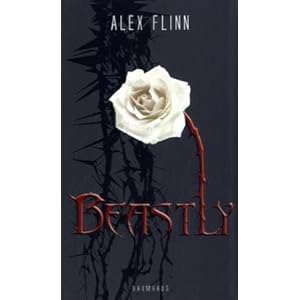
Beastly


Flinn, Alex. (2007). Beastly. New York, NY: Harperteen.
Appropriate for students from seventh grade and up.
Set in modern day New York, this novel is the biggest departure from the original Beauty and the Beast. Not only is the setting different and not only does the author employ chat rooms as story telling devices, but she also chooses to follow the male lead instead of the traditional female point of view.
Best Books/Awards:
ALA Quick Pick for Reluctant Young Adult Readers, 2008
VOYA Editor’s Choice, 2008
Beehive Award, 2010
This book would be interesting in a literacy circle as it is contemporary telling of a fairy tale is likely to get young adults talking about the story and how it relates (or does not relate) to their own lives. Educators could also combine this book in a creative writing class, using the chat room excerpts to show students how they can use modern methods of communication in their stories. Students could create their own chat room situations based on other traditional fantasy or think of other forms of communication that someone like Adrian might use while otherwise locked away from society.

The Lady and the Lion


Long, Laurel, & Ogburn, Jacqueline. (2003). The Lady and the lion. New York, NY: Dial Books for Young Readers.
Appropriate for students in kindergarten to third grade.
Written and illustrated by Americans, this book is based on the Brothers Grimm tale called The Singing, Springing Lark, which actually combined the stories of Beauty and the Beast (French origin) and East of the Sun, West of the Moon (Norwegian origin). Despite all of these Western influences, the bright, deep colors of the oil paintings have an Eastern quality about them. As is the case with many fairy tales, the story claims no home origin and in fact, the protagonist finds herself traveling the world for over seven years.
Best Books:
Children’s Catalog, Nineteenth Edition, 2006
Publishers Weekly Book Review Stars, December 1, 2003

This book is a good read aloud. The oil paintings are beautiful and well matched to the story. It will keep young readers attention and spark their imaginations. This book could also be good in combination with the more well-known Disney version of Beauty and the Beast. Young students could get an early opportunity to find similarities and differences between one of their old favorites and a favorite from centuries ago.